2025's Best New Broadway Productions Featuring Innovative Video Design

As a theater-goer/maker/designer, I’m always inspired by the creative choices made by directors and designers in bringing their stories to life. It’s not easy to transport an audience from an intimate theatre to a completely different world. At Ovation Theatrical Projections, we built our entire company around the belief that digital scenery and effects is often the key to that transformation.
2025 has been an absolute masterclass in this field. It’s been a landmark year for visual storytelling on Broadway, with video designers pushing the artform to places I honestly didn't think were possible yet. During my trip to New York this past year, I was lucky enough to catch a few of these productions live, and I can tell you firsthand: the photos—while beautiful—don’t do them justice.
From high-tech reimaginings of classic novels to intimate portraits of American icons, here is my ranking of the top 10 productions from the 2025 season that utilized video and projection design not just as scenery, but as a vital piece of the storytelling.
A quick note before you dive into the list: All of these shows opened on Broadway between January 1st and December 31st, 2025, so I'd like to give a shout-out to a few shows that opened in the 2024 half of the 2024-2025 Broadway season. Those shows are:
McNeal - Projection Design by Jake Barton (Opened on September 30, 2024)
Yellow Face - Projection Design by Yee Eun Nam (Opened on October 01, 2024)
Death Becomes Her - Video Design by Derek McLane (Opened on November 21, 2024)
Maybe Happy Ending - Video Design by George Reeve; Additional Video Design by Dane Laffrey (Opened on November 12, 2024)
Sunset Blvd. - Video Design & Cinematography by Nathan Amzi and Joe Ransom (Opened on October 20, 2024)
10) Beetlejuice
Projection Design by Peter Nigrini

The ghost with the most made a triumphant return to Broadway this October, haunting the newly renovated Palace Theatre. I actually caught this production when it was touring the United States before this current Broadway engagement, and it blew me away. While it’s no secret that David Korin’s continually evolving house set is the tentpole of the show’s design, Peter Nigrini’s projection design pairs perfectly with the oversized and outlandish physical sets, Kenneth Posner’s brilliantly colorful lighting design, and William Ivey Long’s quirky and clever costumes. Nigrini’s work is a perfect example of how thoughtful, quality video and projection design can expand upon and supplement the other design disciples, adding layers of texture and motion that can’t be achieved otherwise.
Critics were quick to notice how essential these visual elements were to the show's success, often citing the seamless integration of the technical elements. New York Lifestyles Magazine noted that the combination of the auditory and visual tech was overwhelming in the best way, writing that “in Peter Hylenski's sound design, Peter Nigrini's projections, and Jeremy Chernick's special effects, 'Beetlejuice' is elevated into the stratosphere,” going on to say that they “make all the senses tickle throughout the show.” That sensory overload is exactly what makes the show work; the projections allow the titular demon to manipulate the reality of the stage in real-time, making the house feel like a living, breathing, and dangerous entity.
9) The Queen of Versailles
Video Design by Dane Laffrey

Starring Kristin Chenoweth, this new musical based on the documentary of the same name required a set as lavish and excessive as main character Jackie Siegel herself. Dane Laffrey, handling both scenic and video design, created a visual vocabulary that captured the aesthetic of the Siegel’s Versailles-inspired mega-mansion—gold-plated, massive, and ultimately hollow. The video design played a crucial role in layering the reality of the Siegel’s unfinished Florida mansion with the digital gloss of the documentary film crew that follows them. It was a fascinating use of media to comment on the characters themselves, blurring the line between their messy private lives and the public persona they were desperately trying to maintain.
While the show received negative reviews and closed early at a financial loss, the sheer scale of the design garnered a mostly positive response from the press. The Guardian’s Adrian Horton praised the production's magnitude, observing that the live camera work and “stunning scenic and video design by Dane Laffrey... makes for one of the most infinitely layered stages I've seen,” highlighting how the video work added depth to the physical environment.
8) Real Women Have Curves: The Musical
Video Design by Hana S. Kim

This joyful new musical brought a vibrant explosion of culture to the James Earl Jones Theatre. Unlike the darker, more cynical entries on this list, Hana S. Kim’s video design was bathed in warmth and texture. She utilized projections to transport the audience from the cramped, frantic energy of the garment factory to the dreamlike aspirations of the characters. As someone with a directing background, I appreciate when design adds poetic realism, turning simple scenic elements into canvasses for the characters' internal hopes. The way the projections interacted with the surfaces created a sense of place that felt both grounded in Los Angeles and lifted by the characters' dreams.
The critical reception highlighted the design as a standout element of the storytelling. JK's TheatreScene found the projection work to be the emotional glue of the production, stating, "For me though, it is Hana S. Kim's dreamy and poignant video/projection design that was the real icing on the cake." Similarly, Really Tall Guy reviews praised the technical integration, noting that by "blending some of the best projections I have ever seen with wonderful music... these production elements infuse a sense of wonder and culture that strengthens the strongest theme: home." It’s a great reminder that projection design doesn’t always have to be about spectacle; sometimes its most powerful use is to evoke a feeling of comfort and belonging.
7) Oedipus
Video Design by Tal Yarden

Robert Icke’s modern-day retelling of the Greek tragedy transformed the theatre into a high-stakes election headquarters. Tal Yarden’s video design was instrumental here, utilizing live camera feeds, rolling news tickers, and massive screens to create a claustrophobic, media-saturated environment. It made the audience feel like voyeurs watching a slow-motion car crash through the lens of a 24-hour news cycle. The use of live video underscored the lack of privacy for the political family, amplifying the tension by showing us the characters' microscopic reactions on massive screens, ensuring that no secret could remain hidden for long.
The integration of this live video technology was cited by critics as a major factor in the show's overwhelming tension. TheaterMania described the effectiveness of the opening sequence, writing that "the play begins with a pre-recorded video (designed by Tal Yarden) depicting Oedipus rallying a crowd of supporters... scenes Sophocles never imagined, but they effectively make the point." New York Theatre Guide further elaborated on the atmosphere, noting that "Tal Yarden's video work includes a political interview at the beginning and a loop of exit polls on various monitors... [The production is] a powerhouse." It’s a brilliant example of how modern technology can revitalize an ancient text, making the stakes feel immediate and recognizably contemporary.
6) Ragtime
Projection Design by 59 Studio

I was fortunate enough to see the City Center Encores! transfer of Ragtime at the Vivian Beaumont Theater, and it was a masterclass in elegant restraint. Instead of the grandeur of the large sets of the original Broadway production (which a much, much younger version of myself got to see), this production focused their storytelling around the impeccable cast and orchestra and used small, modular physical set pieces and abstract, evocative projections that suggested the shifting landscapes of turn-of-the-century America. It proved that you don't need photorealism to be effective; sometimes a suggestion of shape and motion is enough to let the audience's imagination fill in the rest.
The critical consensus praised how the projections supported the narrative without distracting from it. Time Out New York appreciated the production's visual balance, describing it as "newly outfitted with a spare, effective set by David Korins and attractive abstract projections by 59 Studio." JK's TheatreScene echoed this sentiment, noting that the set was "supplemented by 59 Studio's projections... [creating] a Ragtime that isn't skimpy, fills the enormous stage when necessary, and smartly gets out of the way of the action." For a show as dense and musical as Ragtime, "getting out of the way" is often the hardest and most important job a designer can do.
5) Boop! The Musical
Projection Design by Finn Ross

Bringing a black-and-white cartoon icon into a three-dimensional, technicolor world is a massive design challenge. Finn Ross’s work on BOOP! was the key to its success. The projection design recreated the "Fleischer Studio" style of the Betty Boop cartoons with razor-sharp precision before exploding into color. Just one viewing of the show’s opening number “A Little Versatility Never Hurt,” in which Betty Boop (Jasmine Amy Rogers), steps from one of her cartoons to another with the help of some clever video, prop and costume design, reminded me why we do what we do—it was pure fun. The technical complexity required to match live actors with pre-rendered animation in real-time is staggering, yet Ross made it look effortless, maintaining the whimsy of the source material while leveraging modern tech.
Reviewers were particularly taken with how the projections maintained the integrity of the original animation style. Pages on Stages lauded the commitment to the aesthetic, writing that "the precision of this commitment is reflected in every design element, most strongly in the projection design (Finn Ross)... The monotony of Betty Boop's existence comes through clearly, despite a highly impressive sequence where scenic design... and projection design collaborate."
4) Redwood
Video Design by Hana S. Kim

Idina Menzel’s return to Broadway featured a star turn by the set itself—the majestic redwood forests of California. Hana S. Kim’s immersive video design enveloped the audience, using media to convey the sheer vertical scale and ancient power of nature. It wrapped around the proscenium and extended into the house, placing us at the base of trees that seemed to stretch endlessly upward. This is a prime example of how video can create an environment that physical scenery alone simply cannot replicate; the sense of height and life she achieved was breathtaking. It transformed the theatre into a cathedral of nature, grounding the emotional arc of the character in a setting that felt larger than life.
The immersive nature of the design was the talking point of every review. New York Theater wrote that "through the set, projections, light and sound, the designers envelope us in the tree's majesty, a work of stunning stagecraft that for a few moments even elicits something close to the sort of ineffable feeling of awe one gets in actual Nature." New York Theatre Guide noted that the "video design by Hana S. Kim envelops audiences in places both natural — like amid the redwoods... and abstract — like Jesse's headspace... through the main character's eyes," highlighting how the design seamlessly shifted between the physical world and the internal emotional landscape.
3) Good Night, and Good Luck
Projection Design by David Bengali

George Clooney’s Broadway debut–based on the film of the same name which he starred in 20 years ago–was a stark, stylish drama filmed in real time black and white, blurring the lines between theatre and a live television broadcast. David Bengali’s projection design was central to this concept, using live camera feeds to mimic the claustrophobic framing of 1950s television journalism. It was a fascinating study in how media manipulation works—a theme that is eerily relevant today.
The Guardian observed that the video design enhanced Clooney's performance, stating that "the roving projection (design by David Bengali) allows one to see, in chiaroscuro detail, the gravitas that Clooney did not possess 20 years ago... creased forehead, shadowed eyes, arresting scowl." By using projections to provide close-ups that are usually impossible in a theatre, Bengali allowed for a subtlety of acting that bridged the gap between stage and screen.
2) The Picture of Dorian Gray
Video Design by David Bergman
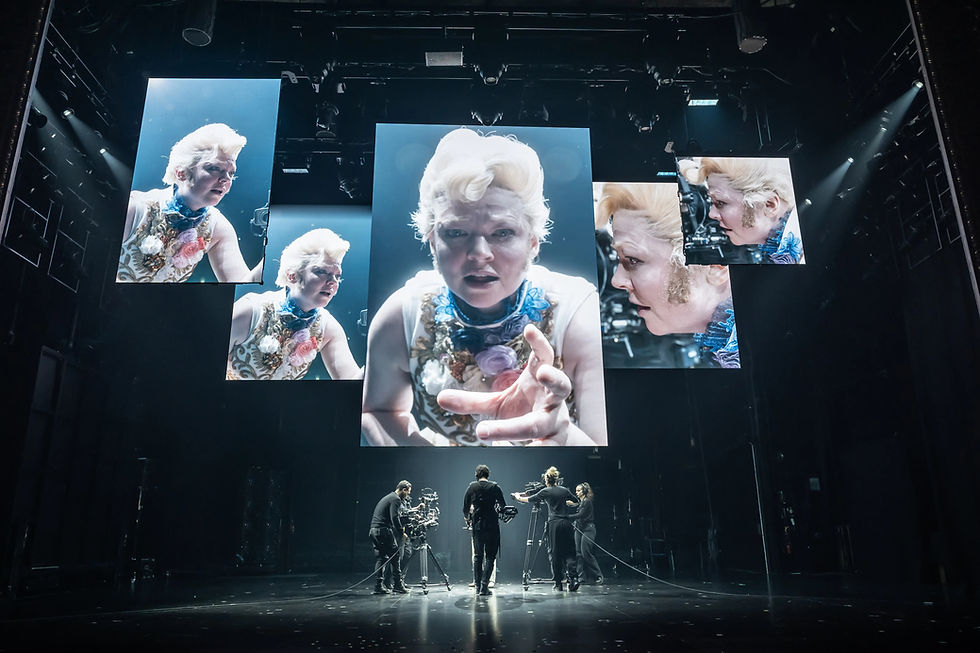
This solo show starring Succession’s Sarah Snook relied entirely on video to populate the stage. David Bergman’s design allowed Snook to interact with pre-recorded versions of herself in real-time, creating a dazzling display of technical wizardry. Screens flew in and out, cameras swirled around the actor, and "live" Snook argued with "video" Snook with such precision that the technology became invisible. It was "cine-theatre" at its absolute finest.
The complexity of this approach left critics stunned. Entertainment Weekly described the experience as a "kinetic experience," noting that "in a clever use of the screens, she often acts against pre-recorded footage of herself — but never trips up... As Dorian Gray is a cautionary tale about the pursuit of eternal youth and beauty, it's only fitting that David Bergman's video design emulates the contemporary era." New York Theater agreed, stating that the "integration can be so effective that it's occasionally difficult to tell whether one of the characters is a recorded projection or not."
1) Stranger Things: The First Shadow
Video Design & Visual Effects by 59

Topping our list is the spectacular prequel to the Netflix phenomenon. I made sure to see this one during my trip to New York, and let me tell you: 59 Productions delivered a masterclass in stage magic. They turned the Marquis Theatre into the Upside Down with terrifying realism. The video design was not just a backdrop; it was a weapon, used to execute jump scares and massive supernatural set pieces that left the audience—and me—gasping. The seamless blending of practical effects with high-end projection mapping created a level of immersion I’ve rarely seen on Broadway. It felt like the future of theatrical design, where the boundaries between physical and digital are completely erased.
The production was universally acclaimed as a new benchmark for theatrical spectacle. TheaterMania called it "an intricate (and incredibly expensive) Rubik's Cube of visual effects and stunning illusions... It's a technical tour de force that leaves you gaping as the enormous letters of the title slide across a screen." Entertainment Weekly summed up the visual achievement perfectly, calling it "immersive, heartfelt, and exhilarating... [it is] a must-see spectacle for the Stranger Things obsessive as much as it is for the theater aficionado who wants to see the medium pushed to new heights."


Comments